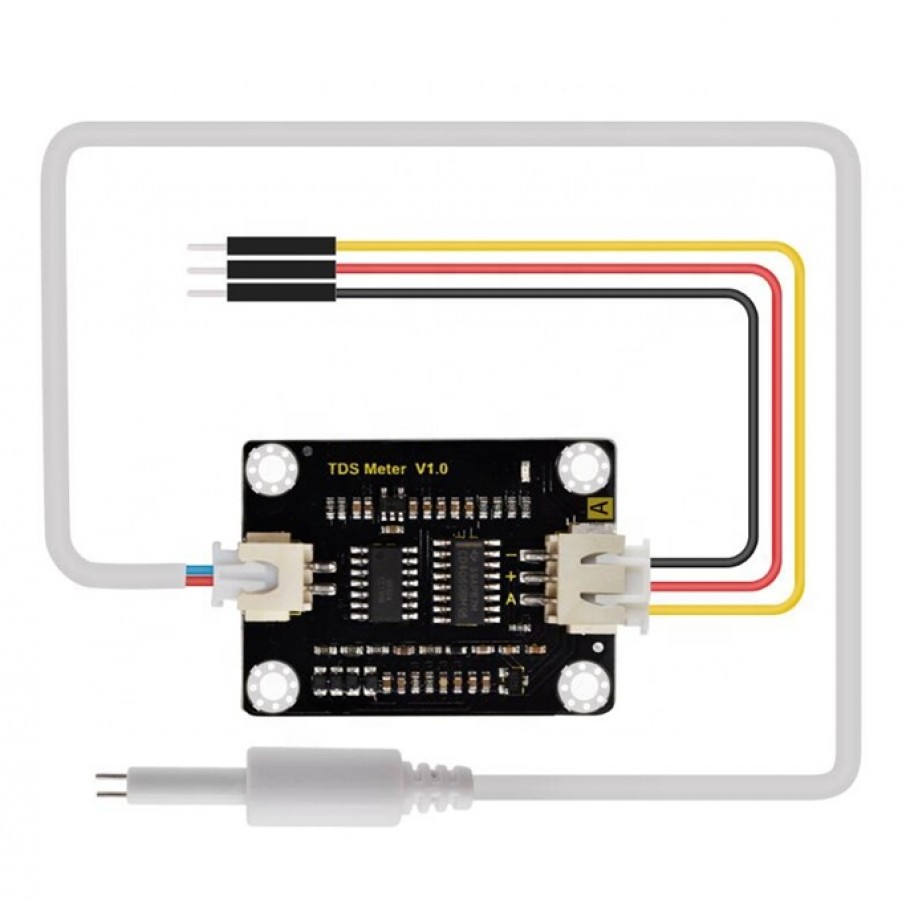
Analog TDS Sensor Module

75,000ج.س.

حساس قياس  إجمالي المواد الصلبة الذائبة  و الموصلية الكهربية للماء

Category:

Description

Analog TDS Sensor Module V1.0 (Gravity-style) — Waterproof Probe, 5V, Analog Output

Meet the Analog TDS Sensor Module V1.0—a compact, stable, and calibration-friendly board for measuring Total Dissolved Solids (TDS) and electrical conductivity (EC) of water. This version pairs a waterproof probe with a precision signal-conditioning board that uses a low-noise op-amp and an onboard oscillator to drive the sensing electrodes with an AC-like excitation—reducing electrode polarization and extending probe life. Read the analog voltage (AO) with your MCU, map it to ppm TDS or mS/cm EC, and you’re ready to monitor RO/DI systems, aquariums, hydroponics, or lab samples.

Highlights

  •  Simple 3-wire host interface: VCC, GND, AO to any 5V microcontroller (Arduino, ESP32 5V-tolerant via divider, etc.).
  •  Linear, low-noise output: Precision conditioning around a LMV324-class op-amp for stable readings with averaging.
  •  AC excitation driver: CD4060-class oscillator helps minimize electrode polarization and measurement drift.
  •  Waterproof probe: Durable stainless electrodes with long lead for immersion measurements.
  •  Trim for range: Onboard trimmer (where present) to fine-tune scaling for your container and target ppm.
  •  Calibratable to ppm or EC: Quick 1- or 2-point calibration using standard solutions (e.g., 1413 μS/cm).
  •  Compact PCB: About 42 × 32 mm with four M3 mounting holes; JST-style headers for neat wiring.
  •  Reverse-polarity hints & silkscreen: Clear “A + –” marking near the host header, probe header keyed.

What you can build

  •  Aquarium & reef monitoring (ATO/RODI quality, dosing checks)
  •  Hydroponics nutrient tracking alongside pH & temperature
  •  RO/DI output quality verification (e.g., alarm when TDS rises)
  •  Education & lab experiments on conductivity/TDS
  • Light industrial water checks (non-hazardous fluids)

How it works

  •  Excitation: The board drives the probe with a low-amplitude AC-like signal derived from a CD4060 oscillator stage.
  •  Sensing: Conductivity of the solution changes the probe impedance; the analog front-end (LMV324 op-amp family) converts it to a voltage.
  • Reading: Your controller samples AO and converts it to EC (μS/cm) and then TDS (ppm) using a temperature-compensated formula and your calibration constants.

Mechanical overview

  •  PCB size: ~42 mm × 32 mm (1.65″ × 1.26″)
  •  Mounting: 4 × corner holes (≈M3)
  • Connectors: Right 3-pin host header marked A + –; left JST for probe (waterproof).
  • Finish: Black PCB, white silkscreen “TDS Meter V1.0”.


Pinout & wiring

Host side (3-pin header, marked near “A + –”):

  • A (AO) — Analog output to MCU ADC
  • + (VCC) — 5 V supply
  • – (GND) — Ground

Probe side (JST header):

  •  Probe + / Probe – — Differential electrodes (most cables: 2 conductors; third pin unconnected on some boards)

Typical MCU wiring

  • AO → Arduino A0 (or to ESP32 ADC with proper scaling/reference)
  • VCC → 5 V, GND → GND
  • Optional NTC/TEMP input: add your own sensor (DS18B20/NTC) for compensation in code.

Quick start (Arduino-style)

  •  Power at 5 V.
  • Immerse the probe in your sample; avoid bubbles or touching container walls.
  •  Rinse between samples with DI water.
  •  Take multiple ADC readings (e.g., average 30–50).
  •  Apply temperature compensation (β ≈ 2%/°C for EC; adjust as needed).
  •  Convert EC→TDS: TDS(ppm) ≈ k × EC(μS/cm). Common k = 0.5 (calibrate to your standard).

Calibration (recommended)

  •  Prepare: 0 ppm proxy (fresh DI or distilled) and one standard (e.g., 1413 μS/cm) or two standards (e.g., 1413 & 2764 μS/cm).
  •  Record ADC in each standard at a known temperature.
  •  Fit linear mapping ADC → EC; store slope & offset in code.
  •  Re-check monthly; clean probe with mild rinse if drift appears.

Best practices

  •  Keep liquid temperature stable; compensate in firmware.
  •  Avoid bubbles and agitation while reading.
  •  Don’t scrape or sand electrodes; rinse instead.
  •  Do not exceed low-voltage aqueous solutions; avoid solvents/acids/alkalis.

Reviews

There are no reviews yet.

Be the first to review “Analog TDS Sensor Module”

Your email address will not be published. Required fields are marked *